Artificial intelligence is already part of how we work, communicate, and make decisions. Integrating it responsibly requires establishing shared criteria, strengthening learning, and defining which decisions require human oversight.
Introducing a tool can be quick. Understanding how it alters processes, relationships, and responsibilities requires a broader conversation. At Empatía Comunidad, we propose viewing this transformation through the lens of people, culture, and leadership.
What kind of culture do we need for working with artificial intelligence?
An organization may have new tools at its disposal while, at the same time, harboring doubts about when to use them, how to review their outputs, or who should take responsibility for a decision. Preparedness is also reflected in the ability of teams to ask questions, share experiences, and recognize their own limitations.
Building a culture of Responsible AI involves agreeing on what we want to use it for, where it can add value, and what conditions we need in order to do so. Communication plays a central role: it makes it possible to explain those criteria, listen to challenges, and revise practices when the context changes.
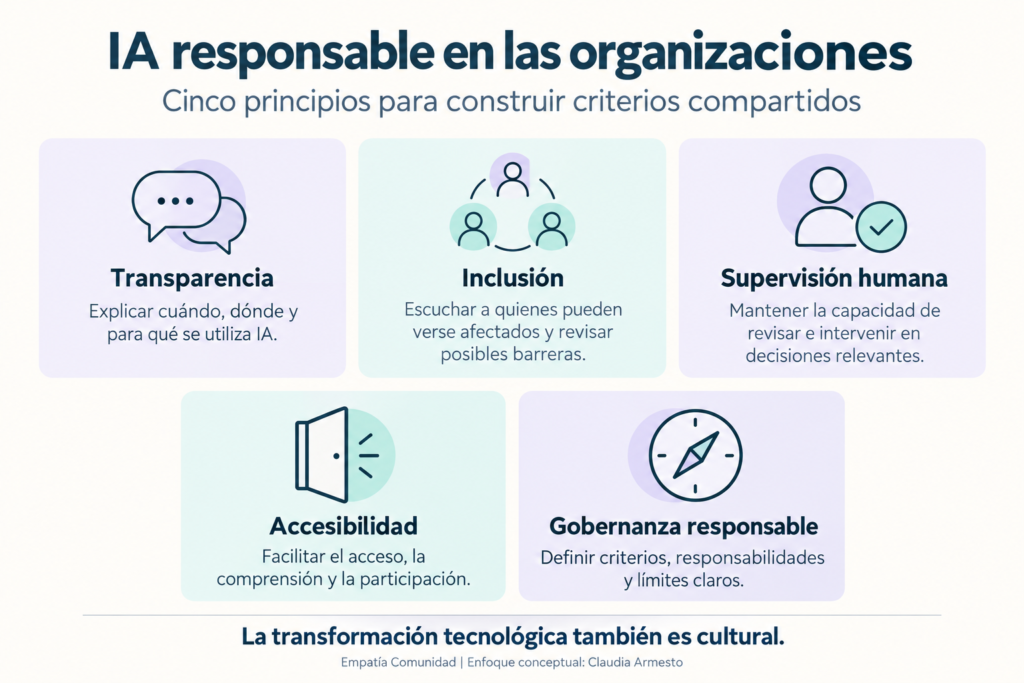
Five principles for starting a conversation
Transparency: to explain when, where, and for what purpose artificial intelligence is used, in a way that is understandable to the people involved.
Inclusion: examine whether its introduction might deepen barriers or inequalities, and listen to those who could be affected.
Human supervition: to retain the ability to review and intervene in significant decisions, with clear responsibilities.
Accessibility: consider who can access the tools, understand their use, and participate in the processes.
Responsible governance: establish shared criteria and limits to guide its use within the organization.
These principles serve as questions for reviewing our practices. Bringing them into daily life requires conversations, training, and decisions that are consistent with each organization’s purpose.
Leadership also needs to learn
The integration of AI poses a challenge for those who lead teams.s: to support learning and create conditions that allow individuals to express questions, identify difficulties, and share what they discover.
Lead this process It involves explaining what is expected of a tool, what kind of review its output requires, and how responsibilities are distributed. It also entails listening to what changes in the teams' work and what skills they need to develop.
Technology can expand possibilities. The meaning we assign to it, the criteria we agree upon, and the attention paid to its impacts are all part of organizational responsibility.
Questions to review how we are incorporating AI
Do we have a shared understanding of when and for what purpose it should be used?
Are there human oversight mechanisms in place for significant decisions?
Do teams receive guidance, and can they seek clarification when they have questions?
Are we taking into account potential biases, barriers, and impacts?
Can we transparently explain how we are using it?
These questions help identify pending conversations and next steps. Listening, learning, and reviewing collectively helps build an integration that is coherent with the culture we wish to develop.
From incorporating tools to building organizational capacity
The technological transformation also alters relationships and decision-making processes. Therefore, an organization prepared to work with AI must foster learning, leadership, transparency, and shared criteria.
The cultural challenge manifests in every practice: how we guide our teams, how we evaluate a response, and how we take responsibility for what we do with it. Integrating artificial intelligence responsibly is an opportunity to revisit the question of what value we want to create—and for whom.
We invite you to watch the educational video from Empatía Comunidad, "AI in Organizations: The Real Challenge Is Cultural," to gain a deeper perspective on technology, leadership, and organizational culture.
A pathway for learning and transformation
At Academia Empatía Comunidad, we support leaders, students, teams, and organizations in developing human competencies related to listening, empathetic communication, leadership, collaboration, and cultural transformation.
This perspective invites us to translate reflection into practice and to develop tools for addressing the current challenges faced by organizations.