After a 2024 marked by caution and a 2025 of reconfiguration, 2026 is shaping up to be the year of smart decisions. In corporate real estate in Buenos Aires, occupiers - and also owners - are adjusting their compass: it is no longer enough to “be” in a good area or to have available space. What is starting to weigh more is the whole equation: product quality, operating costs, flexibility, user experience and, above all, the ability to execute changes without surprises in terms of deadlines and budget.
This shift is clearly visible in premium offices: vacancy remains high and absorption is still irregular, but prices remain relatively stable and future supply under development (projects under construction and planning) is once again putting competitive pressure on the market. In parallel, industrial & logistics closed 2025 with rising demand and strong absorption, reinforcing a scenario where real availability and technical specification are once again decisive. The backdrop is shared: the end user is more professionalised, compares more and negotiates better.
Offices: less “metres”, more performance
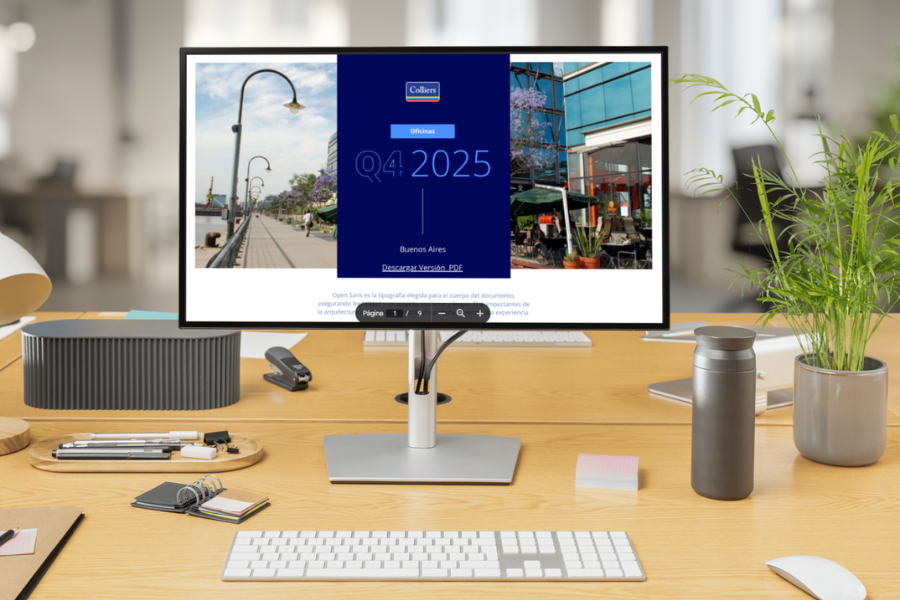
In premium offices, the market enters 2026 with mixed signals. Vacancy closed Q4 2025 at 13,70% and net absorption for the quarter was negative (-18.050 m²), with a total availability of around 271.412 m². Even with these levels of supply, the average asking rent remained stable (22.38 USD/m²).
The tipping point is in the “perceived quality” of the occupant. Searches prioritise buildings that solve operation and work culture at the same time: comfort, technology, services, accessibility and predictable costs. Therefore, 2026 deepens the polarisation: the best positioned assets sustain interest, while secondary buildings need to be repositioned with incentives, improvements and clear value propositions.
Added to this is a competitive factor: future supply is again appearing. By 2026, there is a pipeline of more than 100.000 m², concentrated mainly in Roma Square (39.833 m²), North GBA (36.549 m²) y North CABA (24.095 m²). This on-going offer amplifies a trend: the occupant chooses by fine comparison, not by urgency.
“Companies prioritise more flexible and collaborative spaces, with a focus on wellbeing, technology and user experience. In this scenario, the quality of the product and its ability to adapt to the new way of working are decisive”, notes Juan Manuel Farola, Colliers Argentina Office Director.
What to expect in 2026 (Offices):
- More relevance of the total occupancy cost (rent + expenses + energy + adequacy).
- Increased weight of useful amenities and productivity-oriented design.
- Negotiation more focused on CAPEX, The “fast-track entry” and "fast-track entry".
Industrial & Logistics: speed, specification and class A
In industrial & logistics, it is a different story: the market closed S2 2025 with a net absorption of 137.200 m² (well above the previous semester). Vacancy stood at 6,88% and the average asking rent stood at USD 7.41/m², with values differentiated according to each segment: USD 8.40/m² for class A and USD 6.25/m² for class B. Total inventory reached 2.59 million m²and growth was concentrated in Norte GBA, which also accounts for the majority of the stock (with 68,6% of the inventory) and a profile dominated by Class A products (78,8%).
Looking ahead to 2026, this translates into a more “operational” dynamic: companies value solutions that reduce friction from day one. Real estate is not only evaluated by location, but also by its capacity to absorb processes: access, height, docks, manoeuvring space, security, efficiency and immediate availability. With demand on the move, the tolerance for the “eternal project” is shortened and ready-to-operate options or options with very clear adaptations are the winners.
“After a 2025 with rising absorptions, in 2026 the key will be on the actual availability and technical quality of the product: occupants are prioritising ready-to-operate solutions and ships that reduce operational friction from day one”, explains Alejandro Bartra, Head of Industries and Logistics de Colliers Argentina.
What to expect in 2026 (Industrial & Logistics):
- More decisions guided by operation time.
- More technical requirements and greater preference for Class A.
- More focus on consolidated corridors, with Norte GBA as the thermometer.
The cross-cutting factor 2026: implementation without surprises
The big trend that crosses office and industrial & logistics is execution. Although location and price are still relevant, what ends up tipping the balance is predictability: real deadlines, controllable costs and an implementation that minimises interruptions. In offices, this appears in the demand for adaptable layouts, technological upgrades, comfort improvements and orderly removals; in industrial, in technical adaptations, fine-tuning and “ready-to-operate” solutions.
“In 2026, the differential will be in execution: projects that combine speed of implementation, design flexibility and operational efficiency. The occupier rewards solutions that reduce time and cost uncertainty and allow him to put the space to work without friction, says Lucas Vitello, Director of SPS / Strategic Project Services at Colliers Argentina.
In short, 2026 is shaping up to be a year where the market stops discussing only “metres and price” and starts discussing “performance and predictability”. For owners, the challenge will be to transform assets into competitive propositions; for occupiers, to capitalise on the context with more informed decisions; and for the sector as a whole, to raise the standard of what efficient corporate space means.
Fuentes (Buenos Aires):
- Colliers Argentina, Office Report Q4 2025 (vacancy, absorption, availability, asking rent, pipeline and distribution by submarkets).
- Colliers Argentina, Industrial and Logistics Report S2 2025 (inventory, vacancy, absorption, rents and composition by class/corridor).